
This variation in consumption is the topic of this post. In particular, what is the relationship with drink-driving laws, which put an upper limit on blood alcohol allowed when driving a motorized vehicle?

The consumption information comes from The International Spirit and Wine Record. The graph below shows the data for those 77 countries where estimated wine consumption exceeded 1 million 9-L cases (a dozen bottles) for the year 2017. The vertical bars show us the estimated number of on-premise wine cases as a percentage of the total number of cases of wine. [Note: only every second country is labeled.]

Globally, on-premise wine consumption comprises only 26% of the wine market. However, there are two countries where on-premise wine sales is up to 90% (Indonesia and Laos), and 5 countries where sales exceed 70% (add Cuba, Cambodia and India), although most of these places have only small wine consumption in the first place. At the other extreme, there are 3 countries where on-premise sales are estimated at 0% (Iceland, Iraq and Saudi Arabia), also based on small total consumption.
These are the countries where 2017 on-premise sales exceeded 30% of a large wine wine market:
| India Greece Turkey Vietnam Hong Kong Namibia Italy Argentina Spain Thailand Cyprus Montenegro Croatia Austria Portugal Japan Malta China Malaysia Singapore Kazakhstan France Taiwan Albania |
73.6% 63.8% 60.6% 58.1% 54.0% 49.6% 48.2% 45.7% 41.9% 40.3% 38.8% 38.5% 38.5% 37.4% 36.6% 35.1% 34.3% 33.8% 33.0% 31.9% 31.8% 31.4% 31.2% 30.1% |
Most of these countries are not known for having a strong wine culture, in which case drinking mainly on licensed premises is to be expected. However, there are also European wine-producing countries like Greece, Italy, Spain, Portugal and France, where wine is a standard part of a meal, especially when going out to eat.
Other wine-loving and wine-producing countries are much lower down the list, including the USA (20.2%), New Zealand (15.4%%), Australia (15.0%), the United Kingdom (14.8%), and Germany (11.2%). I suspect that the heavy price mark-ups associated with licensed premises has a strong influence in these countries, encouraging purchases to be made elsewhere. Indeed, places like Australia have a long tradition of BYO (bring your own) wine at restaurants, precisely to deal with this issue — in this case, the BYO purchase will be recorded as off-premise even though the consumption is actually on-premise.
It is also worth having a look at those countries where almost all wine purchasing and consuming is off-premise. These are the countries where 2017 on-premise sales were below 10% of a large wine wine market:
| Finland Lithuania Denmark Slovakia Russia Ukraine Estonia Switzerland Belarus Hungary Poland Uruguay Uzbekistan Moldova Norway Sweden |
10.1% 9.9% 9.9% 9.0% 9.0% 8.5% 8.0% 7.8% 7.5% 5.6% 4.5% 3.7% 3.3% 2.8% 1.0% 0.6% |
Note that most of these countries are from eastern and northern Europe. Many of them do not have a tradition of drinking wine with restaurant meals — indeed, the idea of being a sommelier in these locations would be rather depressing.
It is possible that drink-driving laws play a role in the amount of on-premise drinking, and this is definitely worth looking into (Bob Henry gave me the original hint). The drink-driving information in the following graph is taken from Wikipedia (Drunk driving law by country), which refers to blood alcohol content by volume (BAC).
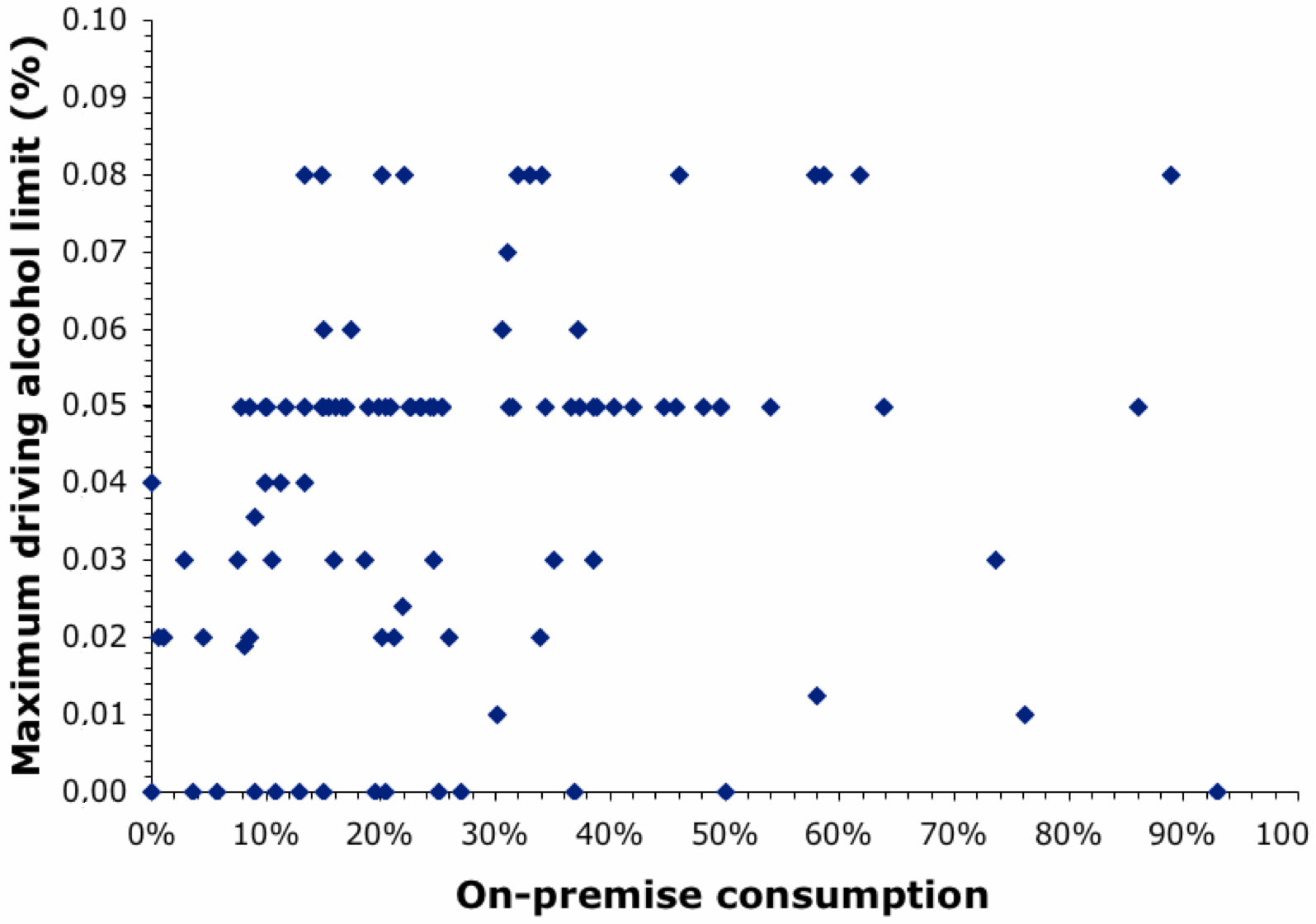
BAC laws are often different for driving commercial vehicles and also for novice drivers — the data in the graph are the standard ones for each country. Laws also differ between states in the USA — in 2017 Utah became the first state to lower the legal limit to 0.05% BAC, which you can see from the graph is the most commonly chosen limit elsewhere. There are also 7 countries that have no specified limit, although most of these are not big alcohol-drinking countries.
Anyway, there is no obvious general relationship between drinking while out and the allowable limit for driving home again. In particular, note that those countries banning alcohol for drivers still have a wide range of on-premise consumption levels.
However, it is notable that those countries with < 10% on-premise consumption do have laws specifying ≤ 0.05% BAC, and mostly ≤ 0.04%. This is unlikely to be a coincidence. For example, Sweden, the country with 0.06% on-premise drinking has a driving limit of 0.02% BAC, which means that drivers almost never drink, and when they do drink it consists of one low-alcohol beer — wine consumption is for the home!
On the other hand, there are plenty of places with equally strict drink-driving laws that seem to have a lot of on-premise wine purchases. In these locations, I hope that people are catching taxis, or taking some other means of transport than their own car.
Still, in the extreme, strict drink-driving laws do seem to have some effect, in the sense of discouraging wine drinking outside the home.
