Monday, October 13, 2025
Which countries prefer Beaujolais wine?
As shown in their graph (included below) the data note that the USA is by far the biggest market, followed by the UK, Canada and Japan. (Note that France is not listed in the graph, because it is not an export market for French products!)
However, this view of the Beaujolais data focuses on the size of the markets, not the amount consumed per person within those markets, which can be thought of as Popularity. In order to look at the latter, we need to take into account the population size within each country.
So, to calculate this, I divided the AAWE country total data by the Worldometer Population 2025 data for each country. However, this refers to all people, not just adults of drinking age. So, I then adjusted the data by the World Bank % people 0–14 years for each country.
This produces the final data as Euros of Beaujolais per Adult, within each country (excluding France). I have illustrated this in the next graph. This is very different from the AAWE graph (illustrating market size).
Note that Luxembourg and Belgium are way out in front in terms of Beaujolais popularity, followed by Ireland and Canada, and then the UK and Norway. Since Denmark and Sweden come next, we can conclude that Beaujolais is very popular in Scandinavia. (I quite like it myself, and I live in Sweden.)
Note that the UK, Canada and Belgium maintain a position near the top of the list in both graphs, while the USA has a very different position (it is a very large market in total).
Anyway, the makers of Beaujolais could focus their promotional activities on the countries as listed in the second graph, just as much as those in the first list.
Monday, June 9, 2025
Finns do not like wine in their alcohol–retailer monopoly
The Finnish government-owned alcohol retailer is called Alko (= Alcohol). It was founded in 1932, and is the only company allowed to sell beverages with an alcohol content >8% in Finland. (NB. wine is typically 12%—14.5% ABV; regular beers are around 5—6% ABV, while stronger craft beers can have an ABV of 6—10%) There are 368 Alko stores and 143 order pick-up points, which is not too bad for a population 5.6 million people, with c. 80% 18 years or older.
So, first, note that normal retail shops can sell full-strength beers and light wines, unlike in Sweden or Norway (where they can sell only light beers). Second, note that there are somewhat more stores than in Norway, in spite of very similar population structures. So, the Finns do quite well, compared to other Nordic countries (I have not yet discussed Denmark in these posts).
The Alko web site indicates that the number of separate items is as shown in the first table. Note that the number is considerably less than in Norway (= 36,148), which is the obvious comparison. This is due, at least partly, to the fewer beers, as expected. However, all of the country numbers are considerably less, as well. Note that the USA does not do too well (see below). France does 50% better than Italy, which does 50% better than Spain.
The Alko web page has versions in Finnish, Swedish and English. The second one is due to the large number of alcohol-buying tourists, as there are daily tourist boats across the Baltic, from Stockholm to Helsinki.
The Alko web site says:
“Alko is a different kind of store. We are legally required to sell alcoholic beverages in a way that reduces the harmful effects of alcohol. Our role has remained the same since 1932 ... Alko's mission is to sell alcohol responsibly and to serve both our customers and Finland’s welfare society as best we can. Our extensive selection brings the whole world to our customers’ fingertips.”
If we take a look specifically at wine, then the Alko collection looks like the second table (click to enlarge). Note that each row simply lists the countries in decreasing order, stopping when it gets to the USA.
These numbers are terrible when compared to those for Norway, being about one quarter in all cases. Finns apparently are not much interested in vinous beverages. Perhaps they prefer low-alcohol versions, which are not necessarily in the Alko stores? Certainly, full-strength wine is not a major contributor to the Finnish economy (unlike its position in the USA: Wine is a major American economic engine).
Anyway, Finland supplies 1,131 alcohol products in the stores, which include: 496 distilled (44%), 340 beer (30%), 100 mixed drinks (9%), 91 fortified (8%), and 34 cider (3%). The large number of distilled beverages include: 166 Liqueur & Bitters, 161 Gin & Other Spirits, 127 Vodka & Spirits, 35 Whisky, and 7 Rum. Also, the 375 USA products include: 175 Red wine (47%), 78 distilled (21%), 70 white wine (19%), and 39 beer (10%).
So, in terms of wine availability, the Finns do not appear to do as well as either the Norwegians or the Swedes, in spite of all three having their government officially owning the alcohol retailer. Iceland also has a government-owned alcohol retailer, Vínbúðin (= The Wine Shop), which is apparently quite strict (Do strict alcohol policies really work?). The remaining Nordic country, Denmark, does not even have an alcohol monopoly system (see: Danish wine imports remained stable in 2024). Interestingly, Greenland and the Faroe Islands, which are self-governing entities within the state of Denmark, do have such retail monopolies.
Finally, it is worth noting that: The Finnish retail alcohol market is being liberalised. Having a government-owned retail store is contrary to official European Union policy, and Finland is finally starting to follow this guideline (it joined the EU in 1995). Sweden was granted an exception for Systembolaget (when it also joined in 1995), but has not yet made any moves to change this. Indeed, the changed Finnish law is creating international tension (How easing of monopoly laws could shift Nordic alcohol markets).
In contrast to this, there is also this sort of attitude: WHO/Europe highlights Nordic alcohol monopolies as a comprehensive model for reducing alcohol consumption and harm. Alcohol consumption is recorded as being lower in the Nordic countries, and this is sometimes attributed to the psychological effect of the government monopoly ownership. This is, indeed, one possible part of Nordic societal attitudes.
One other thing that you may not know about Finland:
- Finland was the first nation in the world to give all adult citizens full suffrage, in other words the right to vote and to run for office, in 1906. Previously, all countries had given this right only to males (and sometimes not even then!).
Monday, June 2, 2025
How well do wine-producing countries do in Norway’s wine retailer monopoly?
Well, it turns out that Norwegians also do quite well when they purchase wines. Their government-owned alcohol retailer is called Vinmonopolet (= The Wine Monopoly). It was founded in 1922, and is the only company allowed to sell beverages with an alcohol content >4.75% in Norway (NB. wine is typically 12%—14.5% ABV; regular beers are around 5—6% ABV, while stronger craft beers can have an ABV of 6—10%). There are 331 Vinmonopolet locations, which is not too bad for a population 5.6 million people, with 4.5 million (80%) 18 years or older.
Their web site indicates that the number of separate items is as shown in the first table. Note that the USA does not do too badly, although this may change any time soon. France does twice as well as Italy, which does twice as well as Germany. It is worth noting at this point that Norway is not part of the European Union.
Their web site says:
“The primary goal of Vinmonopolet is to responsibly perform the distribution of alcoholic goods while limiting the motive of private economic profit from the alcohol industry. Equally significant is the social responsibility of Vinmonopolet, to prevent the sale of alcohol to minors and visibly inebriated customers.”
If we take a look specifically at wine, then the Vinmonopolet collection looks like the second table (click to enlarge). Note that each row simply lists the countries in decreasing order, stopping when it gets to the USA. Note also: Sparkling wine = atmospheric pressure of 5—6 atmospheres, while Bubbly wine = 1—2.5 atmospheres. Strong wine = fortified wine.
Clearly, red wine is preferred to white, and sparkling to rosé. The USA also has 260 beers, and 124 distilled spirits. Norway itself has 909 beers, 774 distilled spirits, 247 ciders, and 117 meads.
So, all in all, the Norwegians do just as well as the Swedes, in terms of wine availability, in spite of their government officially owning the retailer.
Other things that you may not know about Norway include (see also: 25 fascinating facts about Norway, and 14 Misconceptions tourists have when coming to Norway):
- The Nobel Peace Prize is awarded in Oslo (the other prizes are in Stockholm, Sweden, since Alfred Nobel was a Swede) — this caused a sensation at the time of Nobel’s will, because Sweden and Norway formed a union at the time (1901), but Norway was arguing for independence (which it got in 1905)
- there is a small village called Hell (many tourists may be spotted snapping a photo of themselves in front of the station sign)
- skiing both modern (the Telemark ski) and ancient (4,000 year old rock carving) were invented in Norway
- the cheese slicer was invented in Norway, way back in 1925
- there are two versions of the Norwegian language — Bokmål is used by the vast majority of the country, while Nynorsk is more popular in rural areas.
Monday, January 8, 2024
Alcohol control states / countries
Let’s look at this topic here. Basically, what we are dealing at here is an alcohol monopoly of some sort. In one sense, it is used as an alternative to the total prohibition of alcohol consumption — it reduces consumption but not all the way to zero (as in the countries shown in this map, from Wikipedia).
There have been a number of formal studies published in the health literature, looking at a range of countries with different alcohol policies, in order to evaluate the effects of government control of alcohol sales.
For example: Comparative analysis of alcohol control policies in 30 countries.
Donald A Brand, Michaela Saisana, Lisa A Rynn, Fulvia Pennoni, and Albert B Lowenfels. PLoS Medicine 2007 Apr; 4(4): e151. They note:
To assist public health leaders and policymakers, the authors developed a composite indicator — the Alcohol Policy Index — to gauge the strength of a country's alcohol control policies. The Index was applied to the 30 countries that compose the Organization for Economic Cooperation and Development, and regression analysis was used to examine the relationship between policy score and per capita alcohol consumption. The strength of alcohol control policies, as estimated by the Alcohol Policy Index, varied widely among 30 countries located in Europe, Asia, North America, and Australia. The study revealed a clear inverse relationship between policy strength and alcohol consumption.Similarly, a more ambitious study compared several different Indexes and many more countries: Alcohol control policies and alcohol consumption: an international comparison of 167 countries. Joana Madureira-Lima, Sandro Galea. Journal of Epidemiology and Community Health 2018; 72: 54–60. Their conclusion is:
Index scores and ranks from different methodological approaches are highly correlated (r=0.99). Higher scores were associated with lower consumption across the five methods. For each 1 score increase in the ACPI, the reduction in per capita alcohol consumption varies from −0.024µL (95%µCI (−0.043 to −0.004) to −0.014µL (95%µCI (−0.034 to 0.005).So, government control of alcohol availability really does seem to achieve its goal of reducing consumption, without actually eliminating it. The World Health Organization does, of course, have an approving report on this topic: Government monopoly on retail sales.
According to Wikipedia:
[Alcohol monopolies] exist in all Nordic countries except Denmark proper (only on the Faroe Islands), and in all provinces and territories in Canada except Alberta (which privatized its monopoly in 1993). In the United States, there are some alcoholic beverage control states, where alcohol wholesale is controlled by a state government operation and retail sales are offered by either state or private retailers.The graph immediately above is from the paper by Madureira-Lima and Galea, listing the Alcohol Control Policy Index (ACPI) for a range of countries. In this case, the bigger the score then the tighter is the government control.
Note that the USA is a long way down the list, although it is not that far behind the United Kingdom, for example. So, there is some sort of serious government control. Wikipedia lists the 17 control or monopoly U.S. states in November 2019 as:
Alabama
Idaho
Iowa
Maine
Michigan
Mississippi
Montana
New Hampshire
North Carolina
Ohio
Oregon
Pennsylvania
Utah
Vermont
Virginia
West Virginia
Wyoming
Apparently, about one-quarter of the United States’ population lives in these control states.
The figure above also confirms that the Nordic countries have the greatest government control (ie. Denmark, Finland, Iceland, Norway and Sweden are at the top of the list). The World Health Organization has approvingly discussed their situation: Reducing alcohol consumption, the Nordic way: alcohol monopolies, marketing bans and higher taxation.
For those of you who are interested, I have written several relevant posts about the Nordic situation, notably with regard to Sweden (where I live), and often disagreeing with the view of outside commentators:
- Wine monopolies, and the availability of wine
- Which countries are dominated by only a few alcohol suppliers?
- Why is wine often cheaper in Sweden than elsewhere?
- Is Scandinavia currently the most attractive wine export market?
I will finish with a recent pertinent web exchange, about the USA:
Tom Wark
My biggest fear is the rise of institutional Neo-prohibitionism. In my view, the threat of government action against alcohol is greater now than it has ever been.Jeff Siegel:
The solution will require everyone in the wine business — producers, wholesalers, retailers, importers, and the rest — to work together. Which is almost impossible, and may be wine’s biggest problem.
Monday, January 1, 2024
WHO and the use of taxes to reduce alcohol consumption
Gott nytt år! Happy New Year. Bonne année. Frohes Neues Jahr. Feliz año nuevo. Buon Anno!
It has been noted recently that the World Health Organization (WHO) is currently running a campaign to eliminate alcohol consumption throughout the world (WHO shifts its alcohol narratives and the wine industry faces new challenges). As part of this concerted drive, this year the WHO released a Global Report on the Use of Alcohol Taxes. I will look briefly at one aspect of this document here: alcohol taxes.
The report notes:
Alcohol consumption is one of the leading risk factors for population health world-wide. While historically predominantly used to raise revenue, excise taxes are an effective tool to decrease the affordability of alcoholic beverages and reduce alcohol consumption and related harms. However, existing taxes on alcoholic beverages differ widely in terms of design and level, and most are not optimized to pursue health goals.Well, of course they are not! Taxes are principally designed to get money into government coffers, where it can be used for a multitude of things. Improved health may well be one of these things, but taxes are hardly optimized for this use.
Anyway, the report continues:
Amongst the different types of consumption taxes (including excise taxes, value added taxes, or VAT, sales taxes, and import duties), excise taxes are preferred from a public health perspective as they raise the relative price of alcoholic beverages compared to other products and services in the economy, helping reduce affordability.An excise tax is a legislated tax on specific goods or services at the time they are purchased (Excise tax: what it is and how it works). As such, an alcohol excise tax could be specifically arranged to financially address any ill-effects of alcohol on the community, if the government so decided. It is thus more specific than, say, a sales tax (which might apply to many different products).
However, this is all just theory. As WHO further notes, in practice:
As of July 2022, at least 148 countries have applied excise taxes to alcoholic beverages at the national level. However, wine is exempted from excise taxes in at least 22 countries, particularly those in the European Region. Excise taxes should apply to all alcoholic beverages.
Less than 25% of countries surveyed apply ad valorem excise taxes, with the majority of them (around 60%) applying them on the producer (manufacturer) price rather than on the retail price.
Out of the 148 countries that apply excise taxes to alcoholic beverages covered in this analysis, 21 earmark such revenue for various health programmes, including for universal health coverage, the prevention and control of non-communicable disease (NCD), alcohol control, and the promotion of physical activity.
WHO further notes:
Volume-based specific excise represents the most prevalent type of excise tax systems applied to beer and wine, while alcohol-content-based specific excise tax systems are the most prevalent for spirits.The countries involved in these different taxation strategies are shown in the three maps above (taken directly from the WHO report). However, in the case of wine, the WHO need not worry, because Global wine consumption has been declining for a long time, without any changes to the global set of tax systems.
Monday, October 9, 2023
What amount of wine intake maximizes happiness?
I will work at the inter-national level, because that is the dataset that I currently have. Of course, this is a very coarse scale at which to work, but needs must. So, I will compare national wine consumption (average per person) with reported national happiness, for a range of countries, to find the simple relationship between these two things.
My national wine-consumption data come from the International Organisation of Vine and Wine (OIV), who have produced a report on the State of the World Vine and Wine Sector in 2022. This lists the liters of wine consumed per capita, for those 22 countries that consumed at least 2 million hectoliters of wine in 2022 (as shown in the figure above).
This is standard stuff in the wine industry. However, how many of you have also heard of the United Nations’ World Happiness Report? This was also published in 2022; and reportedly:
is based on Gallup surveys where the population estimated their own perceived happiness. The list focuses on factors such as social support, income, health, freedom, generosity, and lack of corruption.You can read up on this set of surveys for yourselves, or you can consult my earlier blog post (Wine and world happiness). However, I wish to make a couple of things very clear about the combined final Happiness score for each of the countries. As you will notice in the following figure, showing the top 24 happiest countries: the Nordic countries occupy six of the top eight places (I currently live in Sweden),* with Australia (where I was born) at no. 12. I refuse to live in a country where the people are unhappy!
Anyway, my objective here is to directly compare wine consumption with happiness, which I have done in the following scatterplot. Each point represents one of the 22 countries, based on both of its data values (consumption horizontally and happiness vertically). The curved line is the quadratic regression, showing the best—fit relationship between the two sets of data. This shows that the happiest people are those with middling wine consumption, rather than either of the two extremes.** This should surprise no-one. Moreover, wine seems to account for nearly 50% of the variation in happiness between countries!
The two pink lines show an average (personal) wine consumption of one bottle per week (on the right) and a half-bottle per week (on the left). The maximum happiness, as estimated from the regression line, is an average of 0.73 liters of wine per week. [NB: a standard wine bottle contains 0.75 liters.]
So, there you have it. Those of you consuming one bottle of wine per week are already doing as well as you can expect. Any less than this and you will be less happy; any more than this and you also risk being less happy. You should note, however, that the recommendation is somewhat less than the traditional: “a glass a day keeps the doctor away” (c. 70% of it, in fact).
As but one example, French prefer rosé to red wine tells us: “according to statistics from the Comite National des Interprofessions des Vins a Apellation D’Origine (CNIV), the average wine consumption [in France] is now 40 litres per person a year rather than 100 litres in 1975.” This change will have resulted in a great happiness improvement for the French!
To me, this can form yet another argument in favor of continued wine consumption, against the current social attacks, where even moderate drinking is considered to be bad for your health (Is alcohol the new tobacco?). My distinction here is between mental health and bodily health — we need to produce more stories about how wine is part of a healthy lifestyle for our minds. This goes along with The Mondavi Defense (as presented by Tom Wark).
I freely admit that this is only an approximate data analysis, since it is at the scale of national averages. For example, the wine data do not account for variations in alcohol content; and nor do the happiness data account for within-country social variation, for example. However, if any of you know of any other way to do this, then I, for one, will be very happy to see the results. Of course, there are also other things that are related to happiness (6 things that make people happy according to scientists).
* You might also like to consult: The steady wine markets of Denmark and Sweden, which notes that “according to Wine Intelligence, there are more weekly wine drinkers in Sweden now than before the pandemic, making up 34% of the population.” If you want to pursue the topic of the cultural differences within the Nordic region, then take a look at The Geography Bible video on: What if the Nordic countries united? (There is also a video about What are the world's happiest and unhappiest countries?)
** In spite of the curvature, this is what is called a “linear effect”. Non-linear effects occur very rapidly, almost in the blink of an eye. A classic example is the recent effects of Climate Change (Why are climate impacts escalating so quickly?).
Monday, September 11, 2023
How we choose which wines to buy / drink
One of the people who has long had an interest in this topic is Liz Thach, a freelance wine writer, wine market expert, researcher, educator and consultant based in Napa and Sonoma. One of her early excursions into the field was back in 2008: How American consumers select wine. Her conclusion was quite simple:
Americans’ reasons may not be that different from other consumers around the world. It turns out that American consumers who are faced with an intimidating wall of wine at grocery stores and wine shops often use the same selection methods as their counterparts in Europe and Asia. Likewise, when handed a wine list at a restaurant, American consumers will rely on the same cues as other global wine consumers.
Recently, she has returned to this field, with a group of colleagues (Andrea Dominici, Larry Lockshin and Leonardo Casini) from several universities: New survey reveals how consumers select wine: Taste trumps price.
For their work, in May 2023 a sample of 2,014 wine consumers was chosen from three countries, all of them major wine markets: Italy, Australia and the U.S.A. As far as the resulting data are concerned, we have been shown a table with a list of the 12 main factors used by the participants when selecting a wine, along with an Importance Score (out of 100 points) averaged for each of the three countries (a higher score indicates a more important criterion of choice). *
Now, speaking personally, I think in pictures, not numbers. So, I need to see a graph of the numbers, if I am going to work out what the numbers are telling me. Here is such a graph, for the tabled data, on the basis that it may help you, too.
Looking at this picture, it is immediately obvious that the wine-consumers of the USA and Australia do not differ much. Indeed, this is confirmed by my statistical calculation of the Correlation Coefficient = 96.1% similarity of their scores. Indeed, the only noticeable (but still small) differences between these two countries are for: Recommendation (USA higher), Variety (USA higher), Brand (USA higher), and Pairing (USA higher).
On the other hand, Italy is in quite a different ball-park. This is also confirmed by the Correlation Coefficients = 71.1% similarity with the USA and 65.7% similarity with Australia. Note that these similarities are not small (ie. they are greater than two-thirds). However, Food Pairing and Region of Origin are shown as massively more important for Italians, while Sustainability is also more important (shame on you Americans and Australians!). Price, on the other hand, is less important for Italians (you need to pay for the good stuff!).
Interestingly, Italians are apparently quite similar to Americans in terms of preference for Grape Variety, and also for Packaging Format. Not unexpectedly, all three countries place Taste as their No. 1 criterion.
Anyway, you can read Liz Thach’s own take on the data in the article linked above. These data have also been discussed (by Hannah Staab) in: 6 major differences between how Italians and Americans buy wine.
My basic question, though, is why is there no mention of what often seems to me to be the most obvious criterion: Value for money. Given two wines of equal quality, the obvious one to choose is the cheaper one; and given two wines of equal price, the one to choose is the wine of better quality. Quality is often measured using some sort of score provided by a wine commentator / critic, or also from wine-drinkers at some community site (or, these days, even from some sort of bot: Wine recommenders are no longer people). Indeed, a value-for-money method is the one that I use most often myself (see my post: Calculating value for money wines) — I care about the other wine characteristics, of course, but I am prepared to try a lot of different wines when it comes to taste.
There is also apparently no mention of Alcohol Content; but that, as a criterion, is a topic for another post.
* The actual methodology of calculation is described in the published article cited above.
Monday, August 28, 2023
The future world of DTC wine selling
Last week, I wrote about The modern (sustainable?) world of wine packaging. Immediately afterwards, three related articles appeared during the week:
- Revino launches groundbreaking end-to-end refillable glass bottle reuse system
- Torres tests reusable packaging
- Could paper bottles be the future of wine and spirit packaging?
This was clearly a hot topic, at the time, and continues to be a pointer to the future.
So, this week I thought that I might write about something just as topical: modern ways of selling wine direct to the consumer / customer (DTC). After all, we have been told that in many places DTC is the lifeblood of the wine industry; and it would be in the USA if it sorts out its cross-state wine transportation problems (Wines are no longer free to travel across state lines). We have also been told, by contrast, that a third of legal-drinking-age adults in the USA say they have not consumed alcohol in the past six months (US consumers want to moderate their alcohol consumption), and especially that Young adults in the U.S. are drinking less than in prior decades. So, wine supply and sale is clearly becoming a more tricky business than it has been — as the French Agriculture Minister recently said: the industry needs to “look to the future, think about consumer changes ... and adapt”. So, DTC should be of relevance.
Obviously, the traditional way to buy wine has been to walk into a retail store and grab a suitable bottle from a shelf. However, one common DTC way to bypass this arrangement has been what is called the Wine Club Model (Clubs vs Subs):
This recurring sales model is structured to offer repeat customers a winery-curated selection of wines at a small discount, delivered to their homes monthly or quarterly. Clubs are typically free to join, and the benefits of being a club member include a discount on wines (typically 10–20%), first access to new releases of wines, and invitations to events. Some wineries will have special seating areas or experiences for participants, and members are encouraged to visit the tasting room for complimentary activities.This model has been common during my adult life (Why are Wine Clubs so popular?), both from producers and from retailers. There are also clubs for supermarket chains, for example, which offer financial discounts each week to their members; and it has also applied to things like newspaper and magazine deliveries to your door.
However, this arrangement apparently does not quite suit modern generations (eg. Millennials and Generation Z), along with many of the other things favored by my (now aging) Baby Boomer generation. The issues seem to be (Clubs vs Subs):
This model is frustratingly rigid. Consumers who grew up with the internet are accustomed to variety, transparency, and immediate access with no strings attached. Moreover, younger consumers don’t want the same wine delivered periodically. They grew up with the internet and know what it is to have options; so, their goal is not to decide on a favorite and stick with it. Instead, they live in a perpetual state of trial.
So, the suggested alternative to the Wine Club is the more general Subscription Model (Clubs vs Subs):
Subscription models are different from Wine Clubs because they place control of the relationship in the customers’ hands. Typically, all interactions are online so that they can be managed anytime and anywhere. Many have apps. The consumer signs up and chooses the frequency and dollar amount. The focus is on new brands and products, typically highlighted with in-the-box extras containing stories about the new items.Indeed, this seems to have become The Way for the younger generations (eg. urbanites 25-45 years old), half of whom apparently have four or more subscriptions, with various providers. Indeed, subscriptions exist these days in all parts of life, from phone usage to apps to video streaming to food delivery. Therefore, the wine industry is being encouraged to re-consider its approach (Wine clubs vs. subscriptions: which is better?); and advice is now being provided for any of we wine oldies who need to adjust to this somewhat different way of selling (Let’s discuss if it is time to move your Wine Club to a Subscription).
One of the many differences between clubs and subscriptions is that The future of pricing centers on the customers. The old approaches to pricing have been: (i) Product-centric Pricing, which is when the prices are set based on their tight link to the cost of production (plus desired profit), (ii) Value-based Pricing, which is when prices are set based on the value that the products or services create for the customers, and (iii) Demand-based Pricing, where increased demand increases the price. Customer-centric Pricing, on the other hand, is not based on maximizing profits for each individual transaction. Instead, it places priority on building long-term relationships with customers, rather than short-term yield, by doing things such as automatically adjusting prices (downward) whether the loyal customers have asked for it or not.
A wine-industry example of how these issues can be addressed is in the recent announcement about wine retail from a traditional figure (ie. my age!) in the wine industry: Wine critic Jeremy Oliver to launch online platform for wine retail:
Australian wine critic and author, Jeremy Oliver, has developed a new online retail platform for wine tailored to user experience, featuring a website and online store with a recommendation engine, an accompanying app and WeChat store, and a library of Oliver’s tasting notes, articles and videos.This is clearly a modern approach (see here for more details: Consumers ‘being fed the lie’), which touches all of the bases highlighted above for what younger adults seem to want in their retail experiences. We should therefore all be interested in how this particular wine business (called Oliver’s Wines) gets on.
To finish on a cautionary note, however, subscriptions are very popular in many places, especially on sites like Youtube, where we are constantly being exhorted to “subscribe to this channel”. This doesn’t stop us also having to watch a set of annoying ads during the next video, or listen to the presenter advertise the “sponsors” of their channel. Even an old guy like me can see that the Subscription Model can become very annoying! You also need to keep track of all of those recurring subscription payments, lest you forget to renew one (Here are the best subscription trackers to help you stay on top of recurring payments). Newer alternatives are therefore definitely also worth exploring (People are sick and tired of all their subscriptions).
Monday, March 13, 2023
Why young people apparently don’t drink wine these days: a summary
The basic issue seems to be quite straightforward. The current market is declining globally, and no new one is appearing to replace it. So, why are modern people not choosing to drink wine? Let's summarize the situation here, in this blog post. (Note: I am not discussing alcohol in general, but wine in particular — Why not choose wine as an alcoholic drink?)
The Baby Boomer generation (now aged 55+) have often drunk wine as a normal part of their culture; but they are (sadly) starting to drop off, and so their group wine drinking is declining. Each new generation seems to reject much of the culture of their parents and grandparents, and so the persons from the subsequent Generation X (age 40-54), Millennial (age 25-39) and Generation Z (< 25 years old) are apparently not all that interested in wine — apparently their uncles drank it, and so they don't. When you combine these two patterns, you potentially have a serious market problem.
There are potentially two issues here: 1) there are reasons why non-wine consumers avoid wine, and 2) there are reasons why wine consumers avoid particular wines.
If we briefly take the second one first, we can briefly note that people these days may be drinking less wine but of better quality. That is, it is the low-end commodity market that is suffering the most, while the high-end premium market may even be increasing. For example, you can read about this two-part idea here:
Why Port production is down, but its quality is up
Wine is still a drink primarily for upper-income college grads
Another reason that is commonly given, as noted by Linda Ovington and her colleagues, is that much wine has too many calories. However, this applies to lots of alcoholic drinks.
Moving on to issue 1), one of the classic examples of the current reduction in overall wine consumption concerns the French (Young France isn’t drinking wine) — also see the graph above:
French citizens remain some of the world's leading consumers of wine, drinking about 55 liters annually, according to a recent study carried out by the University of Montpellier. That's almost six cases a person. But that number has declined more than 50 percent since 1980, when the French drank an average of 120 liters. The drop is chiefly due to changes at the dining room table. The French tradition of drinking wine on a daily basis at mealtimes is practically broken. Perhaps more important for the future, the next generation of French wine drinkers is not learning to consume wine at the dining room table. That's leading to a big change. Roughly 50 percent of young people in France never drink wine, according to the Montpellier report, and less than 10 percent are regular consumers. The rest limit their consumption to two to three times a month.Sadly, this ongoing trend does not apply only to France. For example, the most frequently cited report for the USA, instead, is from the Silicon Valley Bank *, as discussed here:
The wine business sees a problem: Millennials aren’t drinking enough
This SVB report also emphasizes that the issue isn’t necessarily with premium wines or older demographics — expensive wines continue to sell, but bottles that cost less than $15 are not doing so well (The paradox of the US wine industry: falling volumes, yet more regular drinkers).
So, what reasons are being provided by the younger generations for not drinking wine, in particular. Here, is one set of suggestions (Why young people don’t drink wine), which you can make of what you will:
- They don’t drink wine because they are not well informed.
- They don’t drink wine because there are not places which encourage them to do that. In general they are places that smell like they are expensive, elitist and look like they have certain snobbery.
- They don’t drink wine because of the price.
- They don’t drink wine because it has disappeared from the majority of the household tables.
- Finally, they don’t drink wine because their palates (so they say!) are not made for all tastes.
This is an unsolvable problem. The diversity of wine is what makes it intimidating; it’s also what makes it interesting. You can make wine less intimidating only by making it less interesting.
The obvious discussion about dealing with this issue must involve changing the way wine is marketed, for example to something like this (To reach different ages, wineries should try a different marketing approach):
- If you don’t care to understand more about the audience you are trying to reach, then you will miss the mark every time.
- One thing to understand, when it comes to marketing, the secret is not merely selling a product or service. It's about tapping into customer emotions.
- You cannot talk to Millennials like you talked to their parents. This might be a part of the problem that the wine industry has had as a whole.
- The wine industry has always assumed that younger generations would naturally increase their consumption of wine as they grew older, but the truth is that it’s not happening. Wine used to be seen as a premium option, but now many alcoholic beverages, including beer, can also be seen as a status symbol.
- Millennials and Gen Z are also more likely to be health-conscious and seek drinks that fit into their lifestyle, like hard seltzers, leading them further away from consuming wine.
- Where wine used to be seen as a healthy alcohol, it has been replaced in the minds of consumers, thanks to marketing, by hard seltzers and other nonalcoholic drinks that tout better-for-you ingredients.
Finally, there is also, of course, the suggested response of reducing viticulture, as discussed here:
Why do France's winemakers want to destroy their vineyards?
10% of Bordeaux’s vineyard area to be uprooted
* This bank who funded this has just been closed down: Silicon Valley Bank is shut down by regulators in biggest bank failure since global financial crisis; Silicon Valley Bank crisis: everything you need to know about SVB Financial as regulators shut down the bank. Rob McMillan, who compiled the wine reports, has this to say about the future: Silicon Valley Bank: what comes next?.
Monday, March 6, 2023
Is widespread wine tourism safe again, yet?
First, we should take a look at the pandemic data, before we turn to the pandemic effect on the wine industry, and particularly tourism. The easiest data to access come from the Worldometer COVID-19 Coronavirus Pandemic website. Official figures are always minimum estimates, of course, because the officials do not always get to hear about all of the events; and in this case this particularly applies to China (the assumed origin of the virus).
The first graph (above) shows the time course of the number of infected people recorded up to the beginning of February. There were a total of 679,174,044 recorded cases, over the whole pandemic, which is c. 8.5% of the people on the planet. However, more importantly, the graph shows clearly that the global numbers are now as low as they have been at any time since the early stages of the pandemic. Yay!
Prior to this, the two biggest pandemics for which we can estimate their approximate size were the bubonic plague known as the Black Death (1346 to 1353), and the influenza outbreak known as the Spanish Flu (1918). The first of these killed a greater percentage of the people estimated to have been alive at that time, than any pandemic before or since (about one-third of the people in the affected area). The second one infected c. one-third of the people on the planet, without necessarily killing them.
So, for the current pandemic, this next graph shows the time course of the number of deceased people recorded up to the beginning of February. There had been a total of 6,794,531 recorded deaths, which is almost precisely 10% of the number of people who got infected.
So, we are talking about something pretty serious here; and it is little wonder that people stopped traveling from 2020 onwards, and thus exposing themselves to other people who may be infected. Many places declared a State of Emergency (justifiably), and quarantines were implemented by almost every country, putting people in isolation for up to 10 days after getting off a plane, for example.
The consequent effect on tourism will be obvious. Here is a graph illustrating the immediate and dramatic change in travel (Global travel remains subdued in second pandemic year). * This has had all sorts of further effects, from the upsetting (see my post: The (saddest) effect of Covid-19 on the wine industry) to the annoying (see my post: How do Covid-19 lock-downs affect wine blog readership?).
There were other big social effects, of course, but many of these seemed to be temporary, unlike travel. For example: US consumer confidence was recorded to recover within months, not years. This pattern is clearly seen in the next graph, where the measure of confidence was depressed for little more than a year. (Current confidence has subsequently decreased, as we all know, by a recession, not the pandemic.)
Perhaps one of the odder effects occurred in Italy (see the picture below): How Italy is reviving its historic ‘wine windows’ for the Covid era; Italy's "wine windows", used during the plague, reopen for contactless food and alcohol sales.
Anyway, for those of you who have not noticed it, the long-term effects are now officially changing, as well. For example, California has only just now removed its State of Emergency:
After very close to three years and more than 100,000 deaths related to Covid, the nation’s largest state ends its State of Emergency related to the pandemic at 11:59 p.m. tonight (March 1, 2023). On March 4, 2020, California Gov, Gavin Newsom announced the State of Emergency in a news conference carried on virtually every local network amid concern over the state’s first virus-related death, but tonight’s transition will take place with very little public notice.So, someone there has officially answered my blog-title question in the affirmative. This action is based on the second graph above, which clearly shows that the number of deaths is now as low as it has been at any time since the early stages of the pandemic. The pandemic is not necessarily over, but it is damn close — we are now “living with” the disease. (There will continue to be people with what is known as Long Covid, unfortunately.)
Along with this, the media are now starting to sound optimistic, as well:
- Seven wine trends to watch (Wine tourism is set to grow)
- Tourism set to return to pre-pandemic levels in some regions in 2023
- Western Europe sees surge in tourism since the Covid-19 pandemic.
Hopefully, this is not mis-placed optimism. Indeed, we have been told that current air travel has reached 70% (Air travel recovery strengthens in 2022) to 80% (Air traffic recovery is fast-approaching pre-pandemic levels) of its previous scale. Nevertheless, even Shakespeare did warn us long ago: Beware the Ides of March!
Finally, I also hope that it is clear to everyone that being properly vaccinated is a key component of traveling in the immediate future (ie. for the rest of this year, at least). For those of you who do not know, vaccination was invented by a bunch of uneducated women. That is, it started out as a classic Old Wines Tale, which turned out to be absolutely true. These women were cow maids, and the Latin name (vaccination) translates as: The Cow Treatment. I love remembering this, every time I get jabbed. **
* My wife and I are retired, and we had just started doing some international traveling. On the very day that we returned from a bus tour to parts of former Yugoslavia, the first official cases of Covid-19 were brought into Sweden, from people who had gone downhill skiing in northern Italy, during a school break week. So, all of our plans sadly “went out the window”, for the next 2.5 years.
** My wife and I have just had our 6th vaccination dose (ie. a fifth booster dose). We are both biologists who have worked with infectious diseases, so we know just how important vaccination can be, simply because it is such an effective way to avoid getting sick. After all, old-age pensioners like us are recognized as being the ones most at risk, especially when traveling (we have been to both Australia and India in the past year). So, we will have yet another dose later this year, as currently recommended by the Swedish government (which is apparently the only EU country to have yet released their official 2023 vaccination strategy).
Monday, April 25, 2022
Wine recommenders are no longer people
These days, you use an app or a web page. Social interactions have moved in this direction during my lifetime — no longer do we look people in the eye, but we stare at an electronic screen, instead. How does anyone get married, under these circumstances?
Well, there seems to be several quite different ways wine recommendations can be achieved via computing, and I will look briefly at them here. They are not all equally successful (or even easily understood).
First, however, we need to consider what we are using the recommendation for. Am I just looking for a wine to add to my collection, to drink at some future (appropriate) time? If so, then a suggestion from a (suitable) wine commentator is probably what I need. Am I looking for a wine to drink with dinner tonight? In that case it is quite different, because I (presumably) would like to end up with a specific wine, that either goes with the food or impresses the pants off my host. It seems to me that we lump these two extremes together, along with everything in between; and this confuses the issue.
Moreover, there are several possible criteria for choosing a wine. We could, for example, focus on quality, or we could focus on suitability for the occasion, or we could focus simply on whether we actually like it. These criteria do not necessarily need to coincide in terms of choice, under any given circumstances, although it seems desirable that they should do so as often as possible.
The matter of pairing wine with food seems to be a particular bug-bear. At one extreme, it is perfectly simple. For example, if I am going to eat a light white fish in butter sauce, then a hearty red wine would mean that I can’t taste the fish at all. On the other hand, my wife and I have a Sicilian recipe, originally for swordfish but we use it for tuna — it has a lot of strong ingredients, like tomatoes and capers and celery, and I would never be able to taste a light white wine against it. Pairing does not have to be more complicated than this.
On the other hand, sometimes getting the tastes to pair nicely is more tricky. We also have a duck recipe, with which it is suggested that we pair a Pinot Noir. I could not find one in the house, the first time we tried it, so I chose something else. It was a nice wine; but alternating a sip of this wine with a mouthful of duck did not enhance either product. Next time, I made sure I had a Pinot Noir — and it was perfect.
Given the above considerations, there are basically only four types of information that can be used to recommend a wine:
- Quality — scores or descriptions
- Detailed oenological characteristics
- Similarity to your known wine preferences
- Similarity to other people’s preferences
All four of these fail, in one way or another. That does not surprise you, because otherwise we would already have a universal wine recommender by now. So, let’s look at them, one by one.
Quality, variously defined, has traditionally been at the heart of wine recommendations, since time immemorial. It is at the basis of all definitions of fine-wine regions, it is the basis of all wine scoring systems, and it usually is the basis of most wine writing. In the past, Baby Boomers preferred scores (It isn’t polite to point), but these days Millennials apparently prefer words (The importance of online reviews). For a range of suitable recommendation sites, consult: The top wine apps to help pick your bottles. Even putting aside the idea that most wines are never reviewed, and that many reviews might be fakes, the basic issue is still that wine commentators all have different opinions, many of which reek of unadulterated snobbery. As a result, the wine industry has a pretty atrocious reputation — trying to reach “normal people” seems to be an uphill battle (How did Australian beer slobs become wine drinkers?).
So, wine recommendations based on quality miss the basic point — most people care more about value for money than about quality per se. There are definitely web sites based on this idea of value, and they have been successful. However, they all cover geographically and temporally restricted locations. For example, I choose newly available wines based on value for money suggestions from local writers here in Sweden — if two of the three agree, then I am likely to try a bottle. This only works here, and it only works for the few weeks that the wines are available. This is not a general recommendation scheme.
The second recommendation approach is to break the thing being recommended down into each of its minute components, and then try to match those components to the recommendation required. For example, The Music Genome Project claims to be the most comprehensive analysis of music ever undertaken, treating it like a study of the genes in your own body. Your genes, inherited from your parents, act together to create yourself; and we therefore are very interested in studying them, to see how they work. The idea is to do the same thing for music, based on all of its acoustic elements; and the same can also be done for wine (eg. Tastry AI).
The basic problem here is that neither music nor wine exist for us outside of our own minds. That is, our ears detect the sound waves of music, but they then convert them into electrical signals, which they transmit to the brain. Thus, it is our brain that interprets the electrical signals, and calls some of them music and some of them cacophony. The same applies to taste. Atomizing music or wine into the basic components that exist before we hear or taste them deals only with the first part of the experience (Why wine is tasted with your brain, not your palate). The role of perception in food and wine evaluation cannot be over-estimated.
The third approach to recommendation is simply to get you to decide what you like (or want) and then find other products that seem to be similar (eg. My WineGenius). That is, you rate your experiences in some way (words or numbers), and this is used to provide you with new suggestions (these days, based on the computer techniques of artificial intelligence and machine learning). This approach suffers from the same problem as above, that our perceptions occur in our minds; and there are lots of extraneous things that can affect what our minds perceive. Different circumstances lead to different perceptions, so that time, place and prior information all play a role in what we think we like, on any given occasion (eg. The taste of wine can be influenced by music; How Brahms might make your wine taste better). What we liked last time is not necessarily the same as next time.
The fourth approach is somewhat similar to the third one, but instead is based on matching you to other people. That is, you all rate your experiences (using words or numbers), and these ratings are then used to match you to other similar people (once again, via artificial intelligence and machine learning). The recommendations then come from things that those other people rated highly but which you have not yet rated. Perhaps the most (in)famous example of this is movie recommendations from Netflix, but Amazon recommendations work the same way. So, naturally, this approach can be applied to wine (The path to Netflix-quality wine recommendations leads through the doors of perception).
This is sort of how marriages work (as mentioned above). You find someone whom you like, and then see how many things you have in common. The more you find, the better the relationship seems to work, long term. Now, obviously, this analogy breaks down pretty quickly, because married people have to change, in order to adapt to each other’s differences; and the more you adapt, the longer things seems to last. This does not apply to drinking wine, of course, since the wine completely fails to adapt to us. Nevertheless, people are prepared to have a go at this approach, for wine (eg. Clans: The intersection of AI/machine learning with behavioral science).
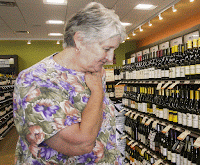
There are lots of different wine recommendation systems out there; and I have mentioned only a few specific ones here. The problem with all summaries of specific recommender systems is that they have a particular agenda — to sell you their particular recommender (and not any of the others). As such, they are very vague, being based on hyperbole rather than information.
So, should we remain optimistic about the idea of a general wine-recommendation system? Well, I still maintain that if we are likely to get one, then we would already have it by now. Sommeliers have been around for a very long time, and they may slowly be getting replaced by computerized systems. However, that does not make the recommendations any better (or worse). As for myself, I still prefer interacting with people rather than computers.


